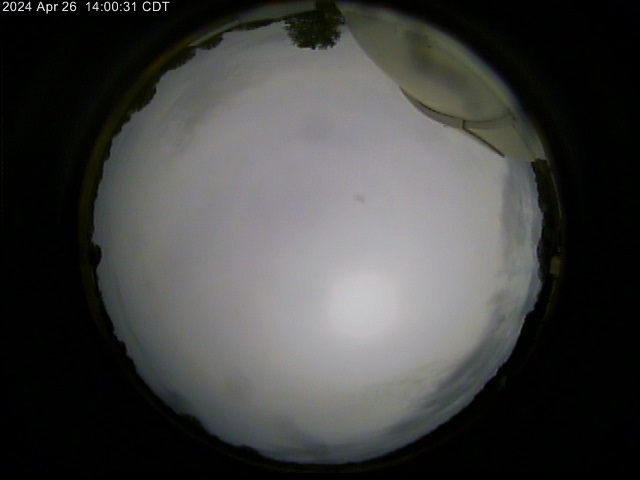
Moonglow Observatory (Warrensburg, Missouri) All Sky Camera
Now you can have an All Sky Cam too, thanks to Moonglow Tech's new All Sky Cam!
Hit Reload or Refresh to get the latest live webcam image. Click here for just the still image.
A low res movie archive is available at Weather Underground.
Flash movie of past 24 hours (updated hourly, right click it for options):
Latest still image (updated every 10 minutes):
Panoramic still image:

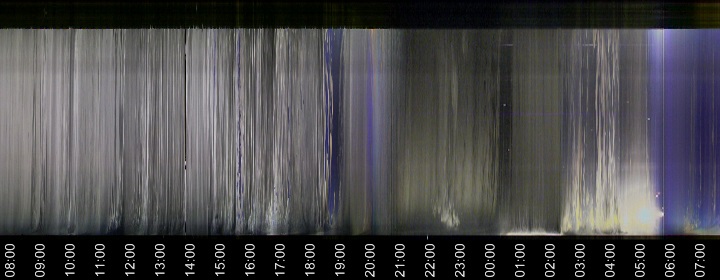
Summary of day (single column of image plotted throughout day):
Latest weather conditions (updated every 10 minutes):
Date/Time: 10/11/26 4:58p Central, Sun: rise 7:21a, set 6:42p
|
Outdoors: temp 87.6°F, hum 44% , dewp 63.0°F, solar 236 W/m²
Rain: 0.00 in, year 31.96 in, Winds: S at 6.0 mph, 10min avg 6.0
Extremes: high 90.9°F, low 54.7°F; Peak winds: gust 17.0
|
Indoors: temp 79.9°F, hum 44% , Baro: 29.917 in
|
Forecast (unreliable!):
Mostly cloudy and cooler. Precipitation likely. Windy with possible wind shift to the W, NW, or N.
|
Click here for metric.
|


|
Weather forecast (updated twice daily):

Cloud camera notes:
- This special camera shows the entire sky, from horizon to horizon, day or night, in all weather rain or shine. North is at the top, east is at the left. The camera is currently located atop Moonglow Observatory (IAU observatory code H27). Later it will be mounted atop the Singmaster Educational Center roof, at the Charles Douglas Memorial Observatory, ICSTARS Ranch.
- This is a day/night color camera. On clear moonless nights the Milky Way is visible. Other astronomical objects like the Moon, planets, and zodiacal light are occasionally visible. Most streaks of light you see are airplanes, this camera catches meteors rarely.
- Image artifacts: During the daytime, intense sunlight will cause a bright vertical bar to appear atop the Sun.
- Technical details: Moonglow Technologies All Sky Cam, digitized by their ASC Uploader.
Click here to return to the home page.
© 2005-2006 Fred Bruenjes - All Rights Reserved. Image inlining (hotlinking) and/or framing are strictly prohibited. No reproduction, dissemination, repackaging, hosting, or other use of these images is allowed without written permission.